
Home for Life: A Guide to Aging in Place
Article Four: The Kitchen: Still the Heart of the Home
Small Changes That Can Help Keep It That Way
Carolyn had been cooking since she was four years old.
She first learned because her mother lived with lupus and arthritis and needed help in the kitchen. Cooking remained part of Carolyn's life for decades afterward, until knee surgery temporarily took away something she had probably never thought much about before: her ability to prepare food independently.

She still knew how to cook. She still wanted to cook. The kitchen had not changed.
Her ability to use it had.
Carolyn eventually began developing ways of preparing food that did not require knives or open flames, and her work attracted people with disabilities, caregivers and occupational therapists. Some told her that those adaptations had helped give them the confidence to prepare meals for themselves again.
There is something worth remembering in that story.
Independence is rarely surrendered all at once. More often, we give it up one ordinary task at a time.
The cast-iron skillet stays in the bottom cabinet because getting down there is no longer worth the trouble. The mixer remains unused because lifting it onto the counter hurts. The roasting pan disappears onto the top shelf because Thanksgiving comes only once a year. A favorite recipe gets made less often because standing at the counter for forty-five minutes has become exhausting.
Eventually someone else begins doing those things.
Yet none of this necessarily means that a person has lost the ability to cook. Sometimes the kitchen has simply become unnecessarily difficult to use.
Fortunately, many of those difficulties can be corrected without remodeling the kitchen at all.
Problem One: The Things You Need Are in the Wrong Place
Open the cabinet where you keep your pots and pans.
If the things you use most frequently require getting onto your knees, bending deeply at the waist, reaching twenty inches into a dark cabinet and then standing back up with something heavy in your hands, the problem is not necessarily age.
It may simply be bad storage.
The first solution costs nothing.
Move the things you use most frequently.
Everyday cookware belongs where it can be reached comfortably. Heavy items deserve particular attention. If the Dutch oven weighs fifteen pounds empty, storing it six inches above the floor guarantees that every use begins with an awkward lift.
Put Christmas cookware in the difficult spaces. Put Tuesday-night cookware in the easy ones.
If rearranging the cabinet does not solve the problem, however, there are inexpensive ways to make the cabinet come to you.
Solution One: A Simple Pull-Out Shelf
A basic pull-out organizer is essentially a basket or shelf mounted on drawer slides inside the existing cabinet. Open the cabinet door, pull the organizer toward you, and the contents that used to live two feet inside the cabinet are now out in the open.
There is no new cabinet.
There is no demolition.
The existing door remains.
Current examples of basic pull-out organizers generally begin around $50 to $100, depending upon width and construction. Many attach to the cabinet floor with only a handful of screws.
Before buying one, however, measure the clear opening, not the width of the cabinet itself.
Open the door and measure between the narrowest obstructions. Hinges often reduce the usable opening. Then measure from the front opening to the back wall and check for plumbing, pipes, electrical wiring or a raised lip at the cabinet face.
That five-minute measurement can prevent the arrival of a perfectly good organizer that is one-quarter inch too wide to pass the hinge.
For a homeowner comfortable with basic tools, many simple bottom-mounted organizers are reasonable do-it-yourself projects. The cabinet generally stays exactly where it is.
For fifty or seventy-five dollars, that can be an excellent return.
Solution Two: Full-Extension, Heavy-Duty Storage
If the cabinet contains cast iron, cookware or small appliances, inexpensive light-duty hardware may not be the right choice.
This is where full-extension, ball-bearing organizers become worthwhile.

The important words are full extension.
A cheap slide that extends only three-quarters of its length may still leave the back several inches of the cabinet difficult to reach. A true full-extension system brings nearly the entire storage platform beyond the cabinet face.
Better systems may also offer soft-close slides, adjustable shelving and load ratings approaching 100 pounds or more.
Expect the hardware to move into roughly the $150 to $400 range, depending upon size and design.
At that point installation also deserves more care. A poorly anchored organizer carrying fifty pounds of cookware can place substantial force on a thin cabinet bottom. Follow the manufacturer's mounting instructions rather than assuming four convenient screws are good enough.
Solution Three: Don't Buy Anything
This deserves equal billing with the hardware.
If the only object causing trouble is the twenty-pound Dutch oven you use twice a year, do not spend $300 engineering a retrieval system for it.
Move it.
Put the saucepan you use four times a week in the easy cabinet and let the Dutch oven occupy Siberia.
Aging in Place is not a shopping list.
The purpose is to make ordinary life easier with the "simplest reasonable solution"
Problem Two: The Upper Cabinet Is Becoming Useless
Upper cabinets create the opposite problem.
You can see the mixing bowl.
You just can't comfortably reach it.
The worst solution is usually a folding step stool.
A step stool converts a reach problem into a balance problem, and that is not much of a bargain.
Again, begin with the free answer.
Move everyday items downward. The top shelf should contain things that are light and seldom used, not the coffee mug you retrieve every morning.
If valuable storage remains inaccessible, however, there is hardware specifically designed for this problem.
Solution One: Add a Lower Shelf
Sometimes the cabinet is poorly arranged rather than too high.
Adjustable shelf pins cost very little, and many cabinets already contain rows of unused adjustment holes. Adding another shelf or lowering an existing one can bring more storage into the useful part of the cabinet.
A precut or locally cut shelf may cost only $15 to $40, depending upon material and size.
This is the sort of improvement worth trying before buying machinery.
Solution Two: A Pull-Down Shelf
A pull-down organizer is a different animal entirely.
Instead of sliding toward you like a lower-cabinet organizer, the entire storage basket moves "out and downward" from the upper cabinet.
Gas-assisted mechanisms help control the weight while the shelf travels. When lowered, items that once required reaching overhead may arrive roughly at chest level.
That can turn an otherwise wasted cabinet back into useful storage.
But measure before falling in love with one.
A current 24-inch Rev-A-Shelf system, for example, requires a wall cabinet with at least a 21-inch opening. It uses a heavy-duty metal frame and side/bottom mounting brackets. The current retail price is about $677 before installation.
That is a long way from a $20 shelf.

It also occupies some of the cabinet space itself. You are trading storage capacity for accessibility.
For someone who relies heavily on upper storage, that may be an excellent trade. For someone who can solve the problem by moving six coffee cups down one shelf, it is ridiculous.
The product should solve the problem—not become the project.
Problem Three: The Mixer Weighs More Every Birthday
Stand mixers are wonderful appliances.
They are also boat anchors with dough hooks.
A substantial mixer can weigh twenty-five or thirty pounds. Store it in a base cabinet and using it may require bending nearly to the floor, lifting the machine upward, turning with it and carrying it to the counter.
For someone with reduced upper-body strength, arthritis or balance problems, eventually the mixer simply stays put.
Solution One: Leave It on the Counter
Cost: nothing.
If you use the appliance regularly and have enough work surface, this is difficult to beat.
A kitchen is a workplace. It does not have to look as though nobody cooks there.
Solution Two: Put It on a Rolling Cart
A sturdy kitchen cart can provide permanent storage and a work surface for a heavy appliance. The important details are stability, appropriate working height and locking casters if wheels are used.
Instead of lifting the mixer from floor level, the homeowner moves the entire cart or works where it stands.
This can also create a place to sit while performing longer food-preparation tasks.
Solution Three: Install an Appliance Lift
Now we get clever.
An appliance lift mounts inside a base cabinet. The mixer sits on a shelf attached to spring-assisted arms. Open the cabinet, pull upward, and the mechanism raises the appliance from storage height to approximately countertop height.
The machine stays on its shelf.
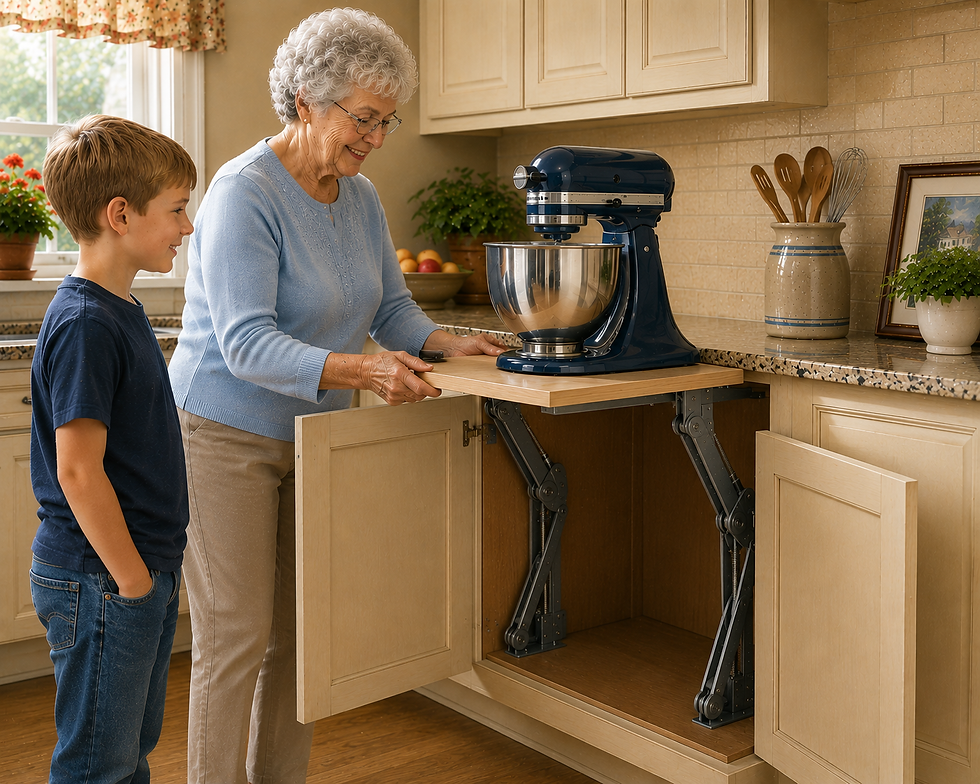
You do not lift thirty pounds from the floor.
Rev-A-Shelf's current heavy-duty soft-close mechanism is rated for appliances up to 60 pounds and fits full-height base cabinets with openings from approximately 12 to 21 inches, depending upon the configuration. The mechanism alone currently sells for about $321 at a major retailer; the manufacturer lists versions from roughly $215 upward, with complete shelf systems costing considerably more.
There is an important detail hidden in that price.
The $321 mechanism does not include the shelf. A suitable shelf must be fabricated and securely attached.
This is therefore not the project I would hand Grandpa with a Phillips screwdriver and tell him to have fun Saturday morning.
A capable woodworker may have no difficulty installing one. For everyone else, a cabinetmaker or experienced handyman is the better call.
Before ordering, confirm the cabinet opening, internal depth, appliance dimensions and appliance weight.
And then ask one more question:
Do I use this machine often enough to justify spending several hundred dollars making it easier to retrieve?
Sometimes the answer is absolutely yes.
Sometimes the correct answer remains, “Leave the mixer on the counter.”
Problem Four: You Can't See What You're Cutting
A bright kitchen can have terrible work lighting.
That sounds contradictory until you stand at the counter.
Ceiling fixtures illuminate the room from above. Your own head and shoulders can cast a shadow directly onto the cutting board beneath an upper cabinet.
The room looks bright.
The onion does not.
For aging eyes, that difference becomes increasingly important.
Solution One: Plug-In LED Task Lighting
This may be one of the best inexpensive improvements in the entire kitchen.
Modern LED under-cabinet fixtures mount beneath the upper cabinets and place light directly onto the work surface.
A current 32-inch linkable LED fixture at Home Depot, for example, sells for about $73. It includes the equipment for either plug-in or hardwired use and offers five selectable color temperatures.
Used as a plug-in fixture, installation can be straightforward: mount the fixture beneath the cabinet, route the cord safely to a nearby receptacle and plug it in.
The drawback is the cord.
Do not solve a visibility problem by creating a dangling electrical cord near a sink or across a walking path.
Solution Two: Link Several Fixtures
If the problem extends across an entire counter run, linkable fixtures allow several lights to operate together instead of requiring a separate switch and cord for each one.
This provides more even illumination and avoids bright spots separated by dark sections.
Expect the equipment cost to increase with every cabinet section illuminated, but the principle remains inexpensive compared with changing ceiling fixtures or opening walls.
Solution Three: Hardwire the Task Lighting
The cleanest permanent installation eliminates visible cords and operates the under-cabinet lighting from a wall switch or approved integral control.
The fixture itself may be the very same $70 light.
The difference is installation.
Once household wiring is being extended or altered, this stops being the casual do-it-yourself portion of our program. Electrical work should comply with local requirements and be performed by someone legally qualified to do it.

The advantage is permanence.
No dangling cords. No occupied receptacle. No plug to reach.
And unlike many “smart kitchen” gadgets, good task lighting is likely to remain useful every single day.
Before buying any fixture, stand at the counter and identify where you actually work.
Light the cutting board, not the cabinet crown molding.
Problem Five: The Faucet Has Become a Hand-Strength Test
A traditional two-handle faucet requires grasping, twisting and often a second adjustment to balance hot and cold water.
For someone with arthritis or reduced grip strength, that little routine occurs dozens of times a day.
Fortunately, this problem has several levels of solution.
Solution One: A Single-Lever Faucet
A large single lever can usually be operated with the hand, wrist or forearm rather than requiring the fingers to tightly grasp and twist a knob.
If the existing faucet is approaching replacement age anyway, this is the simplest feature to look for in the next one.
There is no need for electronics.
There is very little new to learn.
It simply requires less dexterity to operate.
Solution Two: A Pull-Down Sprayer
Combine the single lever with a pull-down spray head and another useful thing happens:
The water can come to the pot.
A sufficiently long hose can make rinsing large cookware easier and may reduce some of the awkward lifting and maneuvering required around the sink.
That does not eliminate the need to empty the hot pot later, but it can eliminate one heavy trip.
Solution Three: Touch or Touchless Operation
If hand dexterity is a significant issue, touch and motion-activated faucets can eliminate much of the mechanical operation altogether.
Wave a hand or touch the appropriate part of the fixture and the water starts.
Current touchless pull-down faucets from established manufacturers can be found around $250 to $300, while premium fixtures can cost substantially more.
That is substantially more than a basic manual faucet.
It also introduces batteries, electronics and sensors that a manual faucet does not have.
So once again, expensive is not automatically better.
If a $100 single-lever faucet completely solves the problem, buy the simple faucet.
If severe arthritis makes even a lever difficult, the more expensive touchless model may buy something far more valuable than novelty.
It may buy independence.
Problem Six: Cooking Has Become Too Much Standing
This problem is often answered with an expensive suggestion to lower countertops.
Not here.
Before changing a countertop, buy a chair.
A stable chair or stool at an appropriate height can allow vegetables to be peeled, ingredients mixed and other preparation performed while seated.
The important word is stable.

A rolling office chair has no business becoming kitchen mobility equipment. Neither does a lightweight folding stool that slides when someone tries to sit.
Look for a broad base, secure footing and a seat height appropriate to the work surface. Arms or a sturdy nearby surface can assist with sitting and rising.
A small kitchen table may already provide the perfect solution.
So might a sturdy cart.
The objective is not to reproduce a commercial accessible kitchen.
It is to let someone continue making dinner without requiring forty-five uninterrupted minutes on their feet.
Sometimes the highest-return Aging in Place modification in the room is simply permission to sit down.
What We Did Not Change
Notice what has not happened.
We have not torn out a cabinet.
We have not replaced the countertops.
We have not widened the kitchen.
We have not hired a designer.
We have not spent tens of thousands of dollars.
We moved cookware.
We brought shelves toward the homeowner.
We brought upper storage downward.
We found a way to raise a heavy appliance instead of lifting it.
We put light where the work occurs.
We made water easier to control.
We found a place to sit.
That is the philosophy behind this part of "Home for Life".
The first question should not be:
How do we remodel this kitchen for an older person?
It should be:
What ordinary task has become unnecessarily difficult, and what is the simplest dependable way to make it easier again?
Sometimes the answer costs nothing.
Sometimes it costs fifty dollars.
Occasionally, the answer may cost several hundred dollars because the problem matters enough to justify it.
But the money follows the problem.
Not the other way around.
The Inspector's Notebook
A home inspector is trained to identify defects.
The faucet leaks.

The disposal does not operate.
The receptacle is damaged.
The range is unsafe.
But "Home for Life" asks us to notice something conventional inspection standards do not.
A perfectly functioning component can still be difficult for its owner to use.
The upper cabinet may be beautifully built.
The mixer may work perfectly.
The kitchen may have plenty of light according to anybody standing in the middle of the room.
The faucet may not leak a drop.
Nothing is defective.
And yet the homeowner may have quietly stopped using part of the kitchen.
That is why this assessment is different from a home inspection.
We are not merely looking for things that have failed.
We are looking for ordinary parts of the home that have begun asking too much of the person who lives there.
Home for Life Assessment — Kitchen Independence
Walk through your kitchen and evaluate each item below. Place a check mark in the appropriate column. The purpose is not to find reasons to spend money. It is to identify the places where a simple correction today might preserve independence tomorrow.
Assessment Item | Already in My Home | Doesn't Apply | Needs Attention |
Frequently used pots and pans can be reached without kneeling or deep bending. | ☐ | ☐ | ☐ |
Heavy cookware is stored where it can be retrieved without lifting it from near floor level or lowering it from overhead. | ☐ | ☐ | ☐ |
Lower cabinets provide practical access to frequently used items without reaching deeply into the cabinet. | ☐ | ☐ | ☐ |
Everyday dishes, glasses and food can be reached without using a step stool. | ☐ | ☐ | ☐ |
Heavy countertop appliances can be used without repeatedly lifting and carrying them from low storage. | ☐ | ☐ | ☐ |
Food-preparation areas have direct task lighting rather than relying entirely on ceiling fixtures. | ☐ | ☐ | ☐ |
Kitchen lighting controls are easy to reach and operate. | ☐ | ☐ | ☐ |
The kitchen faucet can be operated comfortably without tight grasping or twisting. | ☐ | ☐ | ☐ |
The sink sprayer or pull-down faucet reaches the areas where it is actually needed. | ☐ | ☐ | ☐ |
A stable place is available for seated food preparation when standing becomes tiring. | ☐ | ☐ | ☐ |
Frequently used kitchen items can be retrieved without climbing or balancing on a stool. | ☐ | ☐ | ☐ |
Hot or heavy items can be moved between the sink, work surface and cooking area without unnecessary carrying. | ☐ | ☐ | ☐ |
Here's a downloadable version of the checklist:
When you finish, pay particular attention to the items marked "Needs Attention".
Do not turn them into a shopping list.
Instead, return to the solutions in this article and begin with the least expensive correction that actually solves the problem. A cabinet may need a pull-out organizer—or it may simply need the skillet moved. Poor work lighting may justify a $70 fixture. A difficult faucet may require replacement, or the existing handle may already be perfectly manageable.
The assessment identifies the obstacle.
The solution should be proportional to it.
This Week's Home for Life Action
Pick the single kitchen task that requires the most uncomfortable bending, reaching or lifting.
Fix that one.
If the answer is moving the skillet to another cabinet, move it.
If the answer is a $60 pull-out organizer, measure the cabinet properly and investigate one.
If the answer is putting the mixer on the counter, clear the space.
Do not begin with the kitchen.
Begin with "one irritating task".
Then make that task easier.
That is how a home changes without becoming a project.
Trusted Resources
The resources below were selected because they give you somewhere practical to begin investigating the specific solutions discussed in this article.
This is useful even if you never purchase one of their products. Their catalog lets you see how pull-out storage, upper-cabinet pull-down mechanisms and appliance lifts actually work, and their product specifications help you understand what measurements matter before ordering.
This is the approximately $677 example discussed in the article. Look at the photographs and dimensions before deciding whether this type of mechanism solves a real problem in your kitchen.
This is the mechanism that raises a mixer or other heavy appliance from a base cabinet toward countertop height. Notice that the mechanism requires a separate shelf and appropriate cabinet dimensions.
This example can be used either as a plug-in light or installed as part of a hardwired system, making it useful for seeing how the same visibility problem can be approached at two different levels of installation.
Compare this kind of fixture with an ordinary single-lever faucet before spending the additional money. The purpose is not to buy technology. It is to determine whether touchless operation solves a real dexterity problem.
Prices referenced in this article are examples observed while researching this installment and will change. Measure carefully, verify current manufacturer specifications and installation requirements, and confirm local licensing requirements before electrical or plumbing work is performed.
Looking Ahead
There is an encouraging lesson hidden in the kitchen.
Many of the things that make it harder to use are not permanent characteristics of the house at all.
The pot can move. The shelf can slide. The light can be brought closer. The faucet can become easier to operate. The mixer can come up instead of requiring its owner to go down.
Small changes can preserve surprisingly large pieces of independence.
But not every problem can be solved with a screwdriver and a Saturday morning.
Sometimes the difficulty is not inside the room.
It is getting to the room at all.
A bedroom upstairs, laundry equipment in the basement or the only full bathroom at the end of a staircase presents an entirely different kind of challenge. At that point, the question is no longer whether a cabinet or fixture can be made easier to use. It is whether the arrangement of the house itself continues to support the person living there.
In the next installment of "Home for Life", we will step away from individual fixtures and appliances and look at how the rooms themselves are arranged.
Next: One Floor, One Life
Can Your Home Work When the Stairs No Longer Do?
Because a home can contain everything you need and still put it somewhere you may eventually be unable to reach.

Comments