
Home for Life: A Guide to Aging in Place
Article 2 – Falls: The Event That Changes Everything
For most of her life, climbing the eleven concrete steps to her apartment was simply part of Betty Gray's day. She climbed them to collect her mail, visit friends, buy groceries, and return home after church. They were so familiar she probably stopped thinking about them years earlier.

Then one morning, at 85 years old, Betty fell.
Neighbors called for help, and emergency responders urged her to go to the hospital. But Betty hesitated.
Her injuries weren't the only thing on her mind.
If she left her apartment in an ambulance, how would she ever get back up those eleven stairs?
She made a heartbreaking decision.
She refused medical treatment and stayed home—not because she wasn't hurt, but because she feared her own home had become inaccessible.
For months, Betty was effectively trapped inside her apartment. Friends and neighbors brought groceries, checked on her, and helped however they could, but the simple staircase she had climbed countless times had become an impassable barrier. Eventually, she moved into a first-floor apartment where she could once again leave her home independently.
Betty Gray's story, documented by the University of California, Berkeley Graduate School of Journalism, reminds us that the greatest danger from a fall isn't always the injury itself.
Sometimes it's losing the freedom to live in the place you've always called home.
That reality is far more common than most people realize.
Most people think of a fall as a broken bone or an embarrassing trip to the emergency room. While those injuries are certainly serious, the greatest loss is often something much harder to measure.
Independence.
Every year, thousands of older Americans lose the confidence to climb stairs, carry groceries, work in the yard, or even walk to the mailbox because of a single fall. Many begin limiting their activities out of fear that it will happen again. Over time, that fear quietly shrinks the world around them. Favorite hobbies disappear. Visits with friends become less frequent. Even simple errands begin to feel overwhelming.
The encouraging news is that many falls are preventable.
As a home inspector, I've spent years evaluating homes throughout Southeast Georgia. While buyers often worry about roofs, foundations, or heating systems, I've learned that the greatest threats to aging safely are usually much simpler. They're the everyday conditions homeowners have stopped noticing because they've become part of daily life.
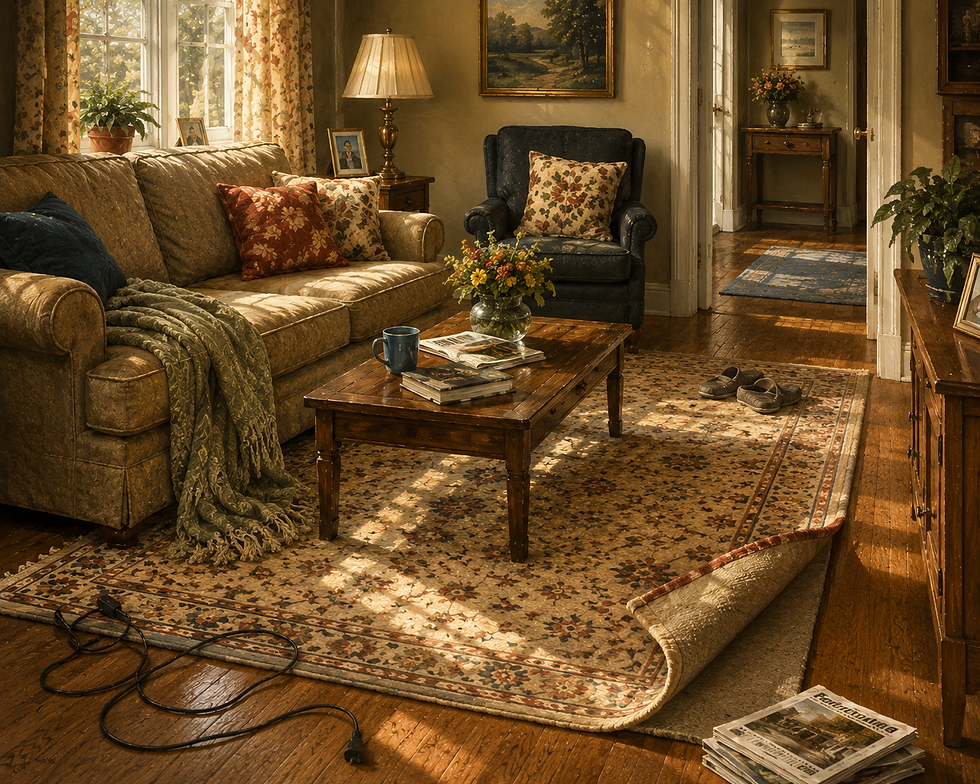
A throw rug that slides across hardwood floors.
A dim hallway that never seemed too dark before.
One uneven step leading onto the back porch.
An extension cord stretched across the living room.
A loose handrail that's been "good enough" for years.
None of these hazards seem particularly dangerous until balance changes, eyesight weakens, strength declines, or reaction times slow with age. Suddenly, the same home that faithfully served your family for decades begins working against you instead of for you.
Light: Your First Line of Defense
One of the simplest improvements any homeowner can make is improving lighting. As we age, our eyes require significantly more light to distinguish changes in floor surfaces, steps, and obstacles. Bright LED bulbs, motion-activated fixtures, and strategically placed nightlights can make moving through the home far safer after dark.
Pay special attention to stairways, hallways, bathrooms, garages, and exterior entrances. A burned-out porch light or a dark hallway may seem like a minor inconvenience until it causes someone to miss a step.
Floors and Walkways
Loose throw rugs, curled carpet edges, cluttered walkways, electrical cords, and shoes left beside the door remain some of the most common trip hazards I encounter during inspections. Creating clear, unobstructed walking paths costs very little, yet it can dramatically reduce the likelihood of a fall.
One question worth asking yourself is simple:
**If the lights suddenly went out tonight, could you safely walk from your bedroom to the bathroom without bumping into anything?**
If the answer is no, your walking path probably deserves another look.
Stairs Demand Respect
Stairways require special care because they combine changes in elevation with the need for balance. Every staircase should have secure handrails that are easy to grasp from top to bottom. Steps should be uniform, well lit, and free of stored items. Even one unexpected change in step height can catch someone off guard.
Never carry large boxes that block your view while using stairs, and avoid balancing on chairs or makeshift step stools to reach high shelves. A few extra minutes spent retrieving a proper ladder is far less costly than weeks spent recovering from a fall.
Your Furniture Should Help You, Not Hurt You
Furniture plays a much larger role in fall prevention than most people realize.
Many people instinctively reach for a nearby chair, table, or sofa when they begin to lose their balance. If that piece of furniture wobbles, slides across the floor, or rolls away on casters, it can actually make a fall worse instead of preventing one.
Look around your favorite walking paths. Are coffee tables forcing you to weave around them? Do dining chair legs extend into the walkway? Are decorative plant stands, baskets, or ottomans narrowing the path between rooms?
The goal isn't to make your home look empty. It's to create wide, predictable pathways that allow you to move confidently through your home.
Furniture height deserves consideration as well. Chairs and sofas that are too low can become surprisingly difficult to stand from as leg strength changes with age. Sometimes a simple furniture riser or firmer cushion can make everyday life much easier.
Think About What Happens *After* a Fall
When our twin boys were learning to crawl, we wrapped the sharp brick edges of our fireplace hearth with protective padding. We knew they were still learning balance, and we wanted to soften the consequences if they stumbled.
As adults, we rarely think that way.
Yet as balance and mobility change later in life, it makes sense to look at our homes through that same thoughtful lens. Sharp brick fireplace hearths, raised hearths, glass coffee tables, stone countertops, decorative benches, and other hard corners deserve a second look.

No one can eliminate every fall.
But reducing the severity of an injury is just as important as preventing the fall itself.
Bathrooms and Exterior Hazards
Bathrooms continue to be one of the highest-risk rooms in any home. Water, smooth flooring, and confined spaces create ideal conditions for slipping. Many people instinctively grab towel bars or shower doors when they begin to fall, but those fixtures usually aren't designed to support a person's weight. Properly installed grab bars and slip-resistant flooring provide far greater protection. We'll explore bathroom safety in much greater detail in our next article.
The hazards don't stop at the front door. Cracked sidewalks, uneven driveways, loose pavers, deteriorated porch steps, poor drainage, overgrown shrubs, and garden hoses stretched across walkways can all become dangerous as mobility changes. These hazards often develop gradually, making them easy to overlook until an accident occurs.
Don't forget the changing seasons. Wet leaves on a porch, holiday extension cords, packages left by the front door, or a rain-soaked welcome mat can temporarily create hazards that deserve just as much attention as permanent defects.
Small Changes, Big Rewards
The purpose of this series isn't to convince you that your home is unsafe.
It's to help ensure your home continues supporting the life you've built there.
Growing older doesn't automatically mean giving up your independence. It simply means recognizing that your home should evolve along with you. Many of the improvements that make a home safer are neither expensive nor complicated. Most simply require looking at your surroundings through a different lens.
This week, I'd encourage you to walk through your home as though you were visiting it for the very first time. Better yet, imagine you're twenty years older than you are today.
What catches your eye?
What makes you hesitate?
What would worry you if your balance wasn't quite what it is today?
You don't have to fix everything at once.
Start with one improvement.
Then another.
Before long, those small changes add up to something much larger—a home that's ready to support you for years to come.
Because preserving the life you love may begin with something as simple as removing a throw rug, replacing a burned-out light bulb, tightening a loose handrail...or seeing your home with fresh eyes for the very first time.
Home for Life Assessment
Article 2 – Fall Prevention Assessment
Every home is different, and every homeowner's needs are unique. This assessment is designed to help you identify opportunities to make your home safer and more comfortable as you age.
As you walk through your home, check each item that applies.
Assessment Item | Already in My Home | Doesn't Apply | Needs Attention |
Hallways are well lit during the day and at night. | ☐ | ☐ | ☐ |
Nightlights are installed where nighttime walking occurs. | ☐ | ☐ | ☐ |
Light switches are conveniently located at room entrances. | ☐ | ☐ | ☐ |
Burned-out bulbs are replaced promptly. | ☐ | ☐ | ☐ |
Throw rugs are removed or securely anchored with non-slip backing. | ☐ | ☐ | ☐ |
Electrical cords do not cross walking paths. | ☐ | ☐ | ☐ |
Floors are free of clutter, shoes, boxes, and other trip hazards. | ☐ | ☐ | ☐ |
Carpet edges are secure and free of curling or lifting. | ☐ | ☐ | ☐ |
Stairways have sturdy handrails that are easy to grasp. | ☐ | ☐ | ☐ |
Stair treads are in good condition and evenly illuminated. | ☐ | ☐ | ☐ |
Items are not stored on stairways. | ☐ | ☐ | ☐ |
Frequently used household items are stored between knee and shoulder height. | ☐ | ☐ | ☐ |
A sturdy step stool or ladder is available when needed. | ☐ | ☐ | ☐ |
Chairs and sofas are easy to sit in and stand up from. | ☐ | ☐ | ☐ |
Furniture is stable and does not wobble when leaned upon. | ☐ | ☐ | ☐ |
Walking paths between rooms are wide and unobstructed. | ☐ | ☐ | ☐ |
Coffee tables, ottomans, and decorative items do not create obstacles. | ☐ | ☐ | ☐ |
Sharp furniture corners or raised hearths have been evaluated for potential injury hazards. | ☐ | ☐ | ☐ |
Bathroom floors have slip-resistant surfaces. | ☐ | ☐ | ☐ |
Grab bars are installed where additional support would be beneficial. | ☐ | ☐ | ☐ |
Outdoor walkways are level and in good repair. | ☐ | ☐ | ☐ |
Porch lights provide adequate illumination after dark. | ☐ | ☐ | ☐ |
Garden hoses, tools, and lawn equipment are stored away from walkways. | ☐ | ☐ | ☐ |
Seasonal decorations and extension cords do not create temporary trip hazards. | ☐ | ☐ | ☐ |
I carry a phone or have another reliable way to call for help if I fall. | ☐ | ☐ | ☐ |
Your Home for Life Notes
Use this space to write down improvements you'd like to make over the coming weeks. Remember, you don't have to complete everything at once. Every small improvement you make today is an investment in your future safety and independence.
__________________________________________________________________________________________________________________________________________________________________________________________________________________________________________________________________________________________________________________________________________________________________________________
Here's a downloadable version you can print to use for your inspection:
This Week's Home for Life Action
Congratulations! You've just completed your first **Home for Life Assessment.** If your checklist looks anything like most homes I inspect, you probably found a few items that could use attention. That's perfectly normal.
Here's one piece of advice I hope you'll remember throughout this series:
**Don't try to do everything at once.**
Many homeowners become overwhelmed when they see a long list of projects. Instead of making progress, they end up doing nothing at all. The secret is to make one meaningful improvement at a time.
This week, choose **one** trip hazard and eliminate it.

It might be removing a throw rug that slides across the floor.
It might be replacing a burned-out light bulb over the back porch.
It might be tightening a loose handrail, moving an extension cord, or rearranging furniture to create a wider walking path.
Whatever you choose, complete it before the end of the week.
Then pause for a moment and appreciate what you've accomplished.
You haven't just completed another household chore—you've made your home a little safer for yourself, your spouse, your family, and every guest who walks through your front door.
Imagine making just one improvement every week.
By the end of a year, your home could be more than fifty safety improvements better than it is today.
That's how lasting change happens.
Not through one massive renovation...
...but through dozens of thoughtful decisions made one at a time.
As you continue reading the *Home for Life* series, keep your assessment checklists together in a folder or binder. Over time, they'll become your own personalized roadmap for aging safely and comfortably in the home you love.
One day, you'll look back through those pages and realize something remarkable.
You didn't just improve your house.
You invested in your independence.
Trusted Resources
The National Council on Aging offers practical information about why falls occur, common risk factors, home safety improvements, balance programs, and ways older adults can reduce their risk while maintaining an active lifestyle.
Published by the National Institutes of Health, this guide explains how changes in vision, balance, medications, and physical activity affect fall risk, along with simple steps to help older adults remain independent.
The CDC provides easy-to-understand information about fall statistics, prevention strategies, exercise, medication reviews, vision care, and creating a safer home environment.
This nonprofit organization helps qualifying older adults and individuals with disabilities make critical home safety repairs and accessibility improvements, allowing them to remain safely in their homes longer.
The National Safety Council offers practical safety guidance for preventing falls both inside and outside the home, including seasonal hazards, housekeeping practices, and safe walking techniques.
Looking Ahead
Most falls don't happen on stairways.
They happen in one room.
The bathroom.
Wet floors, smooth surfaces, stepping over the side of a bathtub, and reaching for towel bars that were never designed to support your weight make the bathroom one of the most hazardous places in any home.
Fortunately, it's also one of the easiest rooms to improve.
In our next article, we'll take a room-by-room look at bathroom safety, including grab bars, walk-in showers, slip-resistant flooring, toilet height, lighting, and simple modifications that can dramatically reduce the risk of injury while preserving both comfort and dignity.
Sometimes, the smallest room in the house deserves the biggest attention.

Comments